
When the Wrist Gives Way: The Subtle Instability Behind Carpal Hyperextension
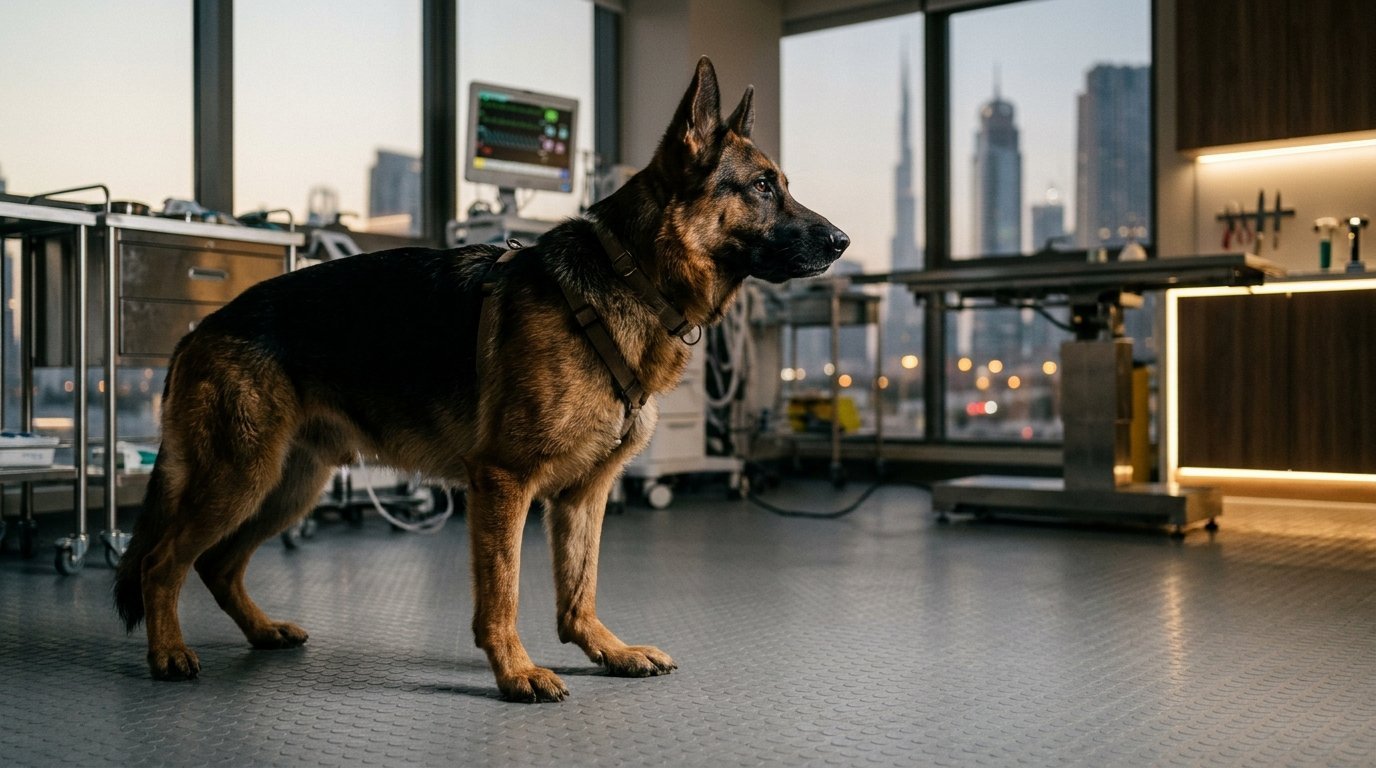
Carpal hyperextension in dogs and cats | Veterinary orthopaedics at Hub Clinics
The limp may be intermittent. The radiographs may show no fracture. Yet something changes when the animal stands: the wrist sinks a little further towards the floor than it should.
In veterinary orthopaedics, that small change in posture can be more revealing than the severity of the lameness.
Carpal hyperextension is not simply excessive flexibility. It can represent a failure of the structures responsible for keeping the wrist stable under load.
The instability that disappears when the paw is lifted
One of the more consequential observations in suspected carpal hyperextension is the difference between examining a limb on the table and watching it support the animal’s weight.
With the paw lifted, the joint may appear relatively unremarkable. Once weight is transferred onto the limb, the carpus begins to collapse into extension.
This distinction matters.
The palmar ligaments and fibrocartilage ordinarily resist excessive extension. When these structures are damaged, the joint may retain some movement while losing the stability required for normal weight-bearing.
The animal may still walk. It may even run. Neither observation establishes that the carpus is mechanically sound.
A normal radiograph does not establish a stable joint
At Hub Clinics, the distinction we consider important is between identifying a fracture and investigating instability.
Conventional radiographs can demonstrate fractures, displacement and degenerative changes. They cannot, by themselves, exclude injury to the supporting ligaments.
When clinical findings suggest carpal instability, carefully performed stress radiographs may help identify which joint level is failing.
That localisation changes the clinical discussion. An injury confined to the lower carpal joints is not necessarily managed in the same way as instability involving the radiocarpal joint.
The question is no longer simply whether the wrist is injured.
It is whether the joint can still support weight without progressive collapse.
Why the timing of the examination matters
A carpal injury does not always follow an obvious accident.
An awkward landing, a jump or an incident that went unnoticed may be followed by subtle changes in stance. Owners may initially notice reluctance to jump, reduced activity or a paw that appears unusually flat against the ground.
In established cases, persistent instability can be accompanied by pain, altered loading and degenerative joint changes.
This is why we regard an abnormal weight-bearing posture as a finding worth investigating, even when lameness appears mild.
For substantial ligament failure, prolonged external support may not restore the joint’s mechanical integrity. Surgical stabilisation, including carpal arthrodesis, may be considered after the affected joint levels and severity have been established.
The decision rests on the nature of the instability, not the appearance of the limp alone.
The observation worth bringing to the consultation
If your dog or cat has begun standing with one wrist noticeably lower than the other, particularly following a jump or fall, we recommend a veterinary orthopaedic assessment.
A short video of the animal standing and walking naturally can be useful, especially when the abnormal posture is intermittent.
At Hub Clinics, our approach begins with identifying where normal movement ends and mechanical instability begins. A detailed orthopaedic examination, supported by appropriate diagnostic imaging, helps determine whether the joint requires protection, further investigation or surgical assessment.
Because sometimes the most significant finding is not how the animal walks.
It is what happens to the joint when the animal stands.
Hub Clinics | Veterinary Care
Hub Pet Veterinary Clinic — Arjan, Dubai
Hub Vet Veterinary Clinic — Sharjah